Your journey into the HVAC industry can start today! Whether you're looking for a quick entry into the field or aiming to enhance your skills, selecting the right training course is vital. This article will explore options for HVAC training that emphasize hands-on experience, equipping you with the essential skills needed for a successful career.
Getting into HVAC usually starts with one simple question: where do you actually learn the work? Some programs promise fast results but offer little time on real equipment. Others take longer but teach skills you will use every day on the job.
Below, we break down the main HVAC training options and explain what kind of hands-on experience each one really offers, so you know what to expect before you enroll.
Exploring Different HVAC Training Programs
If you are considering a career in the Heating, Ventilation, and Air Conditioning (HVAC) industry, the following three main HVAC training programs can help you.
Certificate Programs
Certificate programs are usually offered by community colleges and trade schools and often take 6 to 12 months to complete. Most cost between $1,500 and $8,000, based on school and location.
These programs focus on real shop skills such as wiring thermostats, charging refrigerant, diagnosing airflow problems, and preparing for EPA Section 608 certification.
According to the U.S. Bureau of Labor Statistics Occupational Outlook Handbook, updated in 2025, formal postsecondary training helps entry-level HVAC technicians qualify for jobs faster, especially in residential service roles. These programs work best if you want a quick path into the field and are comfortable starting in junior positions.
Paid Training Programs
Paid training programs are usually run by large HVAC companies, utilities, or industry associations. You learn while working, often as a helper or trainee, and some programs include paid classroom time. In exchange, employers may expect a work commitment after training.
Industry groups such as ACCA have noted in recent workforce reports that employer-led training is growing due to technician shortages in 2025 and 2026. These programs are practical but limited in availability and location.
Apprenticeship Programs
Registered apprenticeships combine paid work with structured classroom instruction over 3 to 5 years. Programs registered with the U.S. Department of Labor follow clear skill standards and wage progression. Apprentices usually earn about 40 to 50 percent of a fully trained technician's pay at the start, increasing as skills improve.
This path takes longer but offers the strongest long-term earning potential and broad hands-on experience across residential and commercial systems.
Core Subjects in HVAC Training
HVAC programs are built around the skills technicians use every day on real job sites. Good training goes beyond theory and focuses on what you will actually install, fix, inspect, and explain to customers.
System Installation Basics
Students learn how furnaces, air conditioners, heat pumps, and duct systems are sized, installed, and connected. Training includes basic load calculations, proper equipment placement, sealing ductwork, and checking airflow.
The U.S. Bureau of Labor Statistics Occupational Outlook Handbook, updated in 2025, notes that employers expect entry-level technicians to understand installation standards before working on their own.
Troubleshooting and Repair Skills
Repair training emphasizes finding the cause of a problem instead of replacing parts at random. Students practice using gauges, multimeters, and diagnostic guides to identify issues like refrigerant leaks, electrical failures, or worn components.
Many programs use common service calls as examples, such as systems that short cycle or struggle to cool evenly.
Controls and Modern HVAC Technology
Most HVAC systems now depend on electronic controls. Training usually covers programmable thermostats, zoning setups, and basic building automation. Students learn how control settings affect comfort and energy use, and how to walk homeowners through simple adjustments.
Industry workforce reports from ACCA in 2025 highlight control-related issues as a frequent reason for service calls.
Maintenance and Efficiency Practices
Maintenance training teaches routine inspections that prevent breakdowns. This includes cleaning coils, replacing filters, checking refrigerant levels, and verifying airflow. The U.S. Department of Energy has reported that regular maintenance can reduce system energy use by up to 15 percent, based on guidance updated in 2025.
Safety and Regulations
Safety is a required part of HVAC training. Students learn electrical safety, proper ladder use, and safe refrigerant handling. Preparation for EPA Section 608 certification is standard, since federal law requires certification to work with refrigerants. Indoor air quality basics are also covered, especially ventilation and moisture control in occupied spaces.
Practical Learning Experiences
- Hands-on learning is a central part of HVAC training.
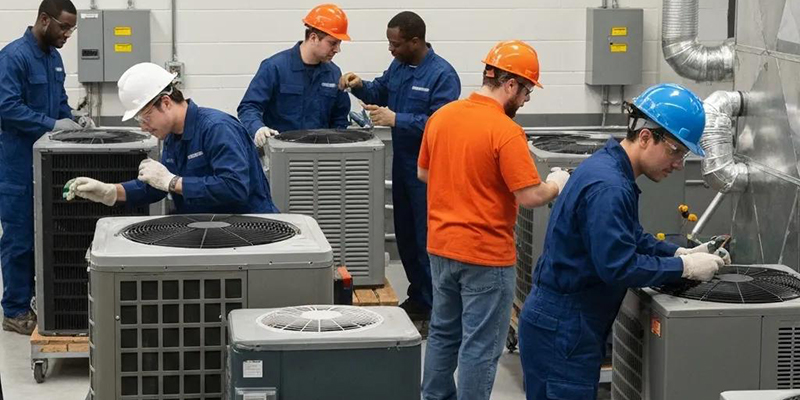
Workshops give students time with real equipment, where they install and level thermostat systems, work with refrigerant lines, balance airflow, and practice basic electrical checks. Doing the work repeatedly helps students gain confidence and remember procedures better than just observing.
- Lab sessions reinforce lecture material in a controlled setting.
Students wire split systems, test pressure, and adjust ducts. They also interpret gauges and safety labels found on actual systems. According to 2025 data from U.S. community college programs, students with more lab experience pass industry certification exams at higher rates.
- Internships with HVAC companies provide real-world exposure.
Students may install equipment, assist technicians on service calls, or perform preventive maintenance. Internships let students apply classroom theory and learn practical troubleshooting methods directly from experienced professionals, smoothing the transition into paid work.
Noteworthy HVAC Schools to Consider
Universal Technical Institute (UTI)
Program: HVACR Technician Program (Diploma)
Length: About 9-10 months depending on campus and schedule
UTI's curriculum covers heating, cooling, refrigeration, basic electricity, safety, EPA Section 608 preparation, and diagnostics. Classes blend classroom lectures with hands-on lab time working on real systems, so you learn both theory and practice.
The program also includes troubleshooting and controls training, preparing you for entry-level HVAC and refrigeration work. Graduates can pursue entry-level roles such as HVAC technician, installer, or refrigeration technician.
More Info: https://www.uti.edu/programs/hvacr
Lincoln Tech
Program: Air Conditioning, Refrigeration & Heating Systems Technology
Length: Around 1,200 clock hours (about 52 weeks) of classroom and lab work
Lincoln Tech trains you on installation, maintenance, repair, airflow testing, refrigerant recovery, and electrical and mechanical concepts using industry-standard tools.
You'll practice with furnaces, central air systems, refrigeration units, and ductwork in lab settings that simulate real job environments. Some assignments may be completed online, but most time is dedicated to hands-on skill building.
More Info: https://www.lincolntech.edu/campus/lincoln-ri/programs/hvac
Penn Foster Career School
Program: HVACR Technician Career Diploma (Online)
Cost: Tuition around $839-$1,139 with payment plan options
Length: Most students finish in about 5-9 months, depending on pace
This online program prepares you for basic HVAC topics including system fundamentals and EPA certification preparation, with flexible pacing to fit your schedule.
Penn Foster includes digital lessons and study guides, and you receive an exam voucher for the EPA refrigerant handling certification. While the coursework itself is online, you should plan to get hands-on practice locally, such as through employer training or lab access, to reinforce skills.
More Info: https://www.pennfoster.edu/programs/trades/hvac-technician-career-diploma
The Refrigeration School (RSI) - Phoenix, AZ
Program: HVAC/Refrigeration Technologies (Hands-On)
Length: About 7 months for the Refrigeration Technologies track
RSI offers practical, lab-based training on HVAC/R systems including installation, service, and repair of comfort and refrigeration equipment. The program covers core system operation, troubleshooting, and real equipment handling.
You also have options for longer programs like Electro-Mechanical Technologies (about 10 months) and a 15-month Associate of Occupational Studies in Mechanical Maintenance Engineering for broader technical roles. Scheduling can be flexible with day, evening, and weekend classes.
More Info: https://www.rsi.edu/programs/refrigeration-technologies/
Central Pennsylvania Institute of Science and Technology (CPIC)
Program: HVAC & Refrigeration (900-Hour Certificate)
Length: 9 months of full-time instruction
This community technical institute offers nearly 900 hours of hands-on and classroom instruction in refrigeration principles, electrical systems, heating and cooling technologies, diagnostics, and installation practices.
Safety and environmental responsibilities are woven throughout the curriculum. The training prepares students for entry-level HVAC/R roles and industry certification exams such as EPA Section 608.
More Info: https://cpi.edu/wp-content/uploads/2025/01/2025-2026CPICatalogwithStudentHandbookJuly2025.pdf
National Technical Institute (NTI) - HVAC Technician Programs
Program: HVAC Technician Training
Length: 3-4 month programs or fusion programs mixing online and lab training
NTI breaks HVAC training into multiple courses that cover core system fundamentals, hands-on lab work, and EPA 608 exam preparation. Flexible schedules include morning, evening, or weekend classes to fit various lifestyles.
The program is designed for beginners and can make HVAC skills accessible in a shorter timeframe compared with traditional school paths.
More Info: https://www.ntitraining.com/training-programs/hvac-technician/
RSI's Electro-Mechanical and Associate Programs
Program: Electro-Mechanical Technologies / Associate of Occupational Studies
Length: 10-15 months depending on track
Beyond the core HVAC/R track, RSI offers cross-discipline training that includes electrical wiring, solar fundamentals, mechanical systems, and extended HVAC/R concepts.
These programs prepare you for broader roles in facilities maintenance or industrial environments where both electrical and HVAC skills are needed.
More Info: https://www.rsi.edu/programs/
How to Select the Right Training Institution
1. Accreditation is the first factor to check.
Schools approved by recognized agencies meet minimum standards, and employers often prefer graduates from accredited programs. Accreditation ensures the curriculum covers essential skills and safety practices that are valued in the field.
2. Instructor experience matters.
Teachers with years in HVAC can explain issues in ways newcomers understand and share real job-site tips. For example, they can demonstrate safe electrical work, effective communication with homeowners, and tool organization to improve efficiency.
3. Student outcomes reveal a school's effectiveness.
Graduation rates, job placement statistics, and alumni feedback show how well past students succeed in the workforce. Many technical schools and community colleges report this data publicly or in state education board performance reports.
4. Flexibility is important for students with other responsibilities.
Evening or weekend classes, or programs mixing labs and lectures at different times, help people balance work, family, and training. Flexible schedules allow students to complete programs without giving up income while gaining hands-on skills.
Launch Your HVAC Career Today
Demand for HVAC technicians continues to rise as homes and commercial buildings rely more on climate control, energy upgrades, and ongoing maintenance.
According to the U.S. Bureau of Labor Statistics Occupational Outlook Handbook updated in 2025, employment for HVAC technicians is expected to grow faster than the average for all occupations, driven by system replacements and new construction.
Hands-on training helps you build the skills employers look for from day one, from basic installation to routine service and safety practices. If you are ready to move into the field, the next step is simple: compare programs, confirm hands-on lab time, and choose a training path that fits your schedule and budget.